
The challenge
Innovation was recognized as critical to the organization's future growth, yet translating ambition into repeatable results remained challenging. Ideas existed across the business. Teams were experimenting with new products, services and technologies. Individual innovation initiatives demonstrated potential, but the organization lacked a consistent system for moving from opportunity identification to validation, development and commercialization.
Like many established organizations, innovation was often constrained by existing processes designed to optimize today's business rather than discover tomorrow's opportunities.
The challenge was therefore not simply generating more ideas. It was answering a more important business question: how could the organization build a repeatable innovation capability that identifies the right opportunities earlier, accelerates learning and systematically transforms promising ideas into meaningful business value?
The approach
peergroup approached innovation not as a workshop, methodology or isolated process, but as an interconnected organizational system. The engagement began by examining the organization's existing innovation ecosystem, its strategy, portfolio, people, capabilities, processes, governance, culture, resources and relationships with internal and external stakeholders.
This provided a clear picture of where innovation was working, where opportunities were becoming constrained and where greater organizational capability was required.
Working collaboratively with business, innovation and design leadership, peergroup developed an integrated approach connecting opportunity discovery, human insight, experimentation, validation and business viability: innovation priorities connected to business strategy; emerging consumer, market and technology opportunities identified; insights translated into clearly defined opportunity spaces; stronger multidisciplinary teams; human-centered opportunity development; rapid prototyping and assumption testing; iterative learning and validation loops; desirability, feasibility, viability and value evaluated; stronger portfolio decision-making; governance and ways of working that enable innovation to progress; and internal capabilities connected with external expertise and ecosystems.
Rather than asking teams to predict which ideas would succeed, the approach enabled them to generate evidence, reduce uncertainty and learn their way toward stronger opportunities. Innovation became less about having the right idea at the beginning, and more about building the organizational capability to discover, develop and validate the right opportunities.
The outcomes
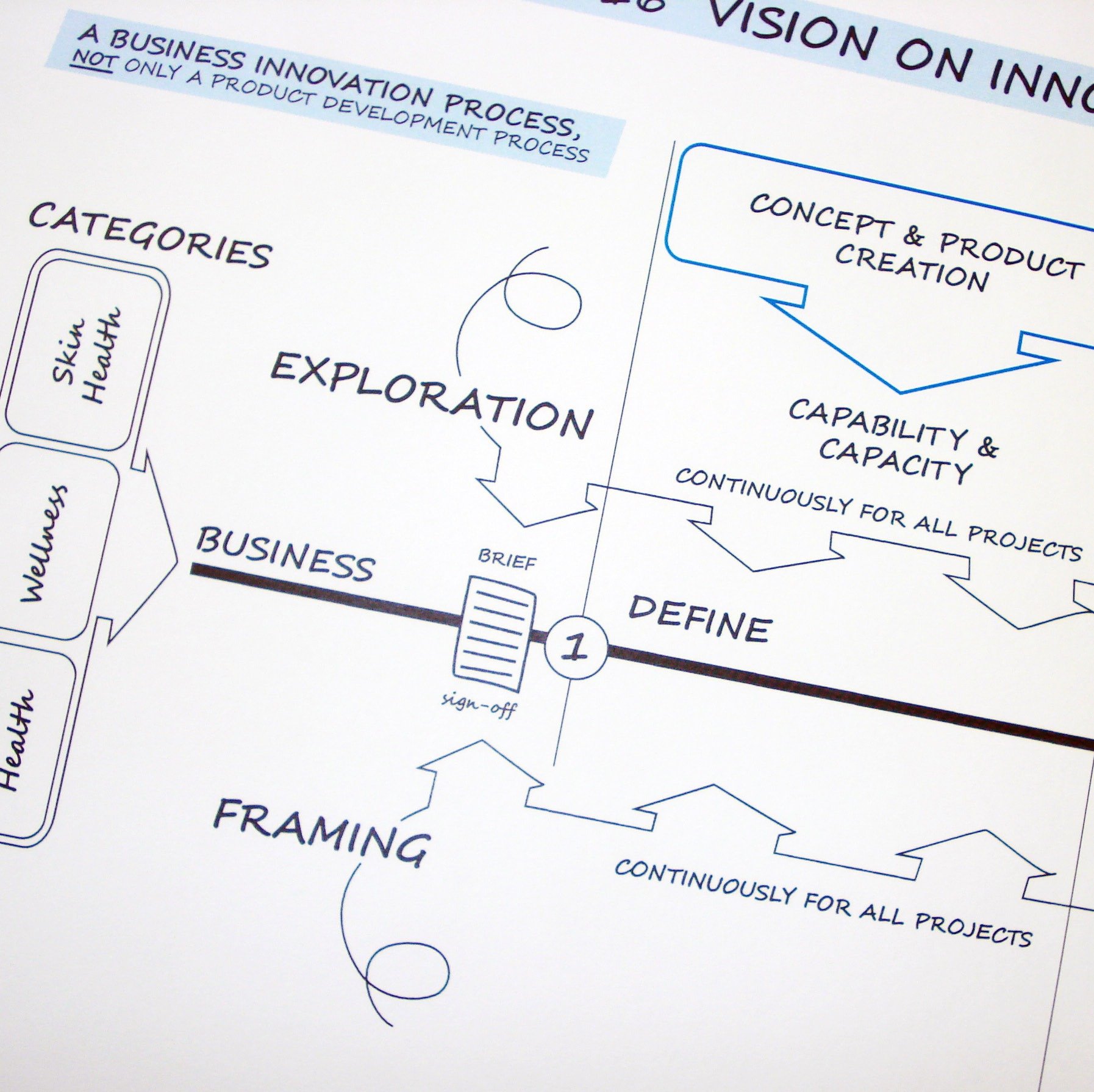
The engagement established a more systematic approach for moving opportunities from initial insight through experimentation, validation and eventual investment. Teams gained a shared innovation language, common methodologies and practical tools for evaluating opportunities earlier and making more informed decisions about where to invest organizational resources.
Equally important, innovation became more closely connected to the strategic ambitions of the business. The organization could identify promising opportunities earlier while recognizing weaker propositions before significant resources were committed.
Innovation was increasingly understood not simply as a creative activity, but as a disciplined process for managing uncertainty and creating future value.
The value created
PEOPLE: Built multidisciplinary innovation capabilities and created greater collaboration between design, business, technology, research and other critical functions.
PLANET & SOCIETY: Expanded opportunity development beyond immediate commercial considerations to examine the broader human, societal and environmental implications of future products, services and business models.
PROFIT & PERFORMANCE: Strengthened the organization's ability to identify higher-potential opportunities, validate assumptions earlier, allocate resources more effectively and build a stronger pipeline for future growth.
The mindset shifted
Innovation is not about generating more ideas. It is about building the organizational capability to repeatedly identify the right opportunities and transform them into value.